
Meteora
The Meteora is a rock formation in the regional unit of Trikala, in Thessaly, in northwestern Greece, hosting one of the most prominent complexes of Eastern Orthodox monasteries, viewed locally as second in importance only to Mount Athos. Their height is more than 20 metres (66 ft).
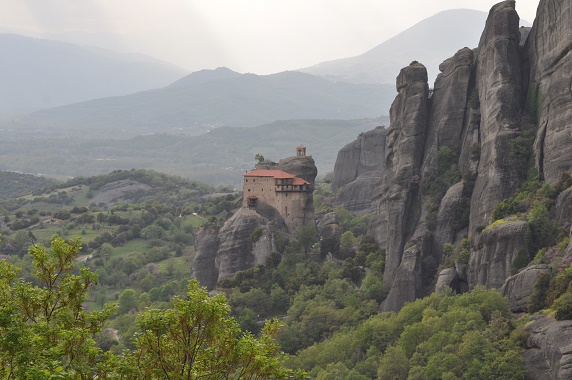
Twenty-four monasteries were established atop the giant natural pillars and hill-like rounded boulders that dominate the local area, mainly from the second half of the 14th century under the local rule of Simeon Uroš. As of December 2025, four of the original monasteries were occupied, in active use as monasteries that are managed by monks, and open to visitors: the monasteries of Great Meteoron (est. 1356), Varlaam, Holy Trinity, and Saint Stephen – the latter became a convent run by a community of nuns in 1961. Two other former monasteries are extant, yet no longer in active use as monasteries: the Saint Nicholas Anapausas and Rousanou monasteries.
Meteora is located in between the town of Kalabaka and the village of Kastraki at the northwestern edge of the Plain of Thessaly near the Pineios river and Pindus Mountains. The Meteora complex, comprising the six extant monasteries, was added to the UNESCO World Heritage List in 1988 because of its outstanding architecture and beauty, combined with religious and cultural significance.
Μετέωρα is one of the most impressive natural and cultural landmarks in Greece. It is a unique geological area with towering rock formations rising steeply from the Thessalian plain, atop which historic monasteries have been built. Meteora combines breathtaking natural beauty with spiritual and cultural heritage, offering visitors stunning landscapes, unique architecture, and a sense of peace and reverence rarely found elsewhere.
LINKS.